
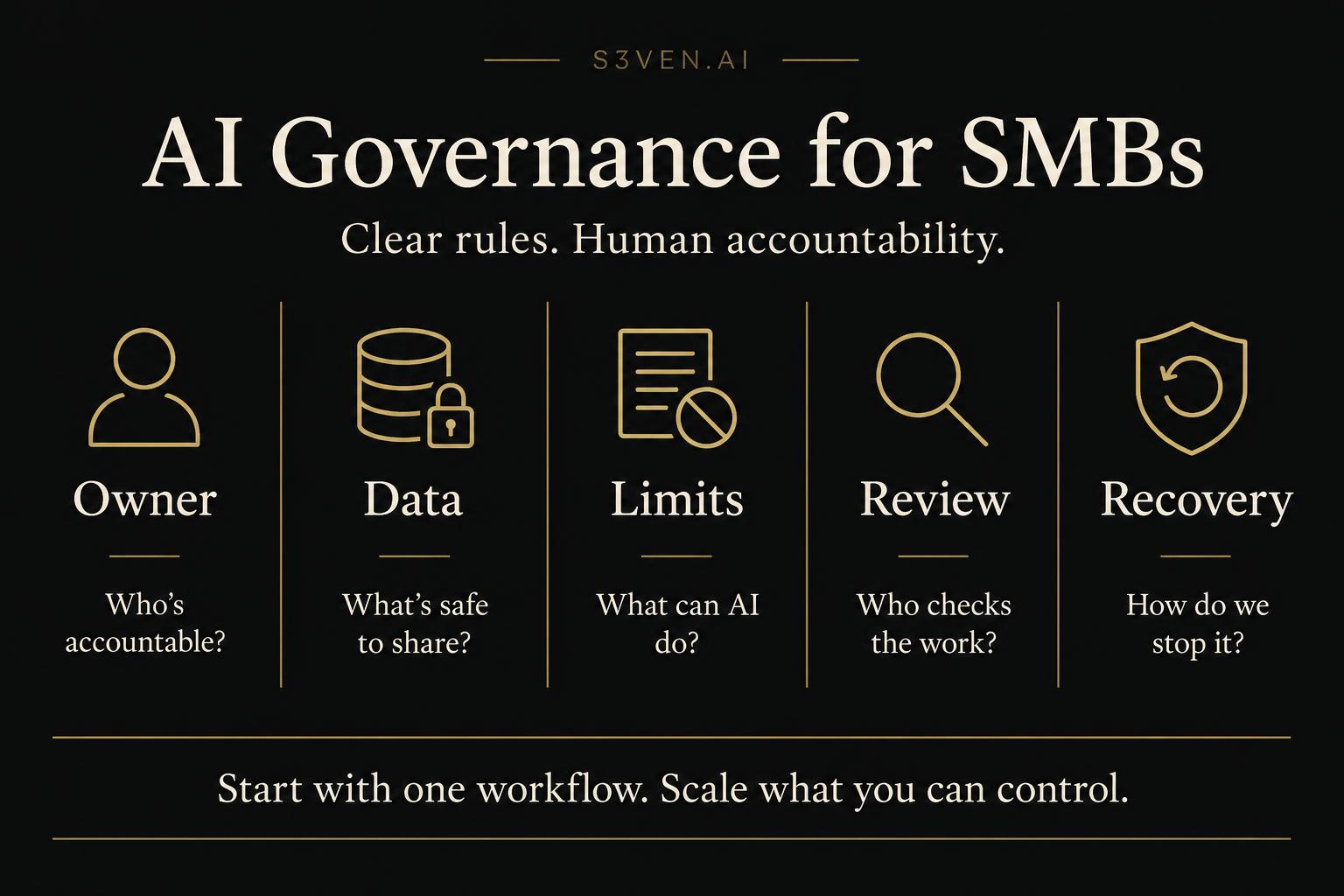
AI governance is how your business decides what AI can do, what data it can use, who checks its work, and who’s accountable when something goes wrong. For a small or mid-sized business, it’s the practical operating discipline that keeps AI useful without handing it authority your business can’t afford to lose.
You don’t need an enterprise committee to get started. You need clear boundaries around the work you’re already doing. If someone’s using AI to write proposals, summarize customer calls, screen applications, or answer inquiries, governance already matters—even if nobody’s called it that yet.
Why AI governance is critical for SMBs
A tool can produce a polished answer without producing a correct one. An assistant can respond quickly while sharing information it shouldn’t. An automated workflow can turn one mistake into repeated mistakes before anyone notices.
For a small business, those failures land close to the owner: a customer complaint, an incorrect quote, exposed information, or hours spent untangling an avoidable problem. Governance won’t eliminate every risk. It gives you a way to decide which risks are acceptable, prevent predictable errors, and respond when controls fail.
- Protect customer trust. Define what AI can say on your behalf and when a person needs to step in.
- Protect information. Decide which tools can handle customer records, employee details, pricing, and confidential documents.
- Protect decision quality. Don’t mistake a confident answer for verified evidence, especially when money, people, or safety are involved.
- Protect your investment. Give every workflow an owner, a measurable purpose, and a review process so subscriptions don’t become unmanaged experiments.
The goal isn’t to slow adoption. It’s to make adoption dependable enough that you can keep using it.
Buying a trusted tool doesn’t govern your business
A provider’s safeguards matter, but they don’t decide how your staff use the tool, which records they upload, or whether an automated message makes an unauthorized promise. Those are business decisions.
The NIST AI Risk Management Framework organizes risk management around four functions: Govern, Map, Measure, and Manage. It’s voluntary and designed for organizations of different sizes. In everyday terms: establish responsibility, understand the use case, evaluate what can go wrong, and manage the risks throughout operation.
That’s a useful starting point—not a certificate of compliance. Your legal obligations depend on where you operate, the data you handle, and how you use AI.
Five questions every AI workflow needs to answer
1. Who owns the outcome?
Name a person who’s accountable for the workflow, not just the person who bought the software. That owner approves changes, reviews failures, and makes the call to pause the system. In a small team, it might be the owner, operations manager, or sales lead.
If everyone assumes the vendor’s responsible, nobody’s managing what happens inside your business.
2. What data can it use?
Create a short approved-tools list and specify what each tool can receive. Public service descriptions aren’t the same as payroll records, customer account details, or confidential contracts. Don’t upload sensitive information to an unapproved tool just because it saves time.
Before approving a vendor, ask how inputs and outputs are stored, whether they’re used for training, who can access them, and what deletion and retention options exist. Review the actual account settings and contract rather than assuming every product has the same protections. Use only the information a workflow needs.
3. What can AI do without approval?
Separate drafting from acting. Creating a proposed response is different from sending it. Suggesting an appointment is different from changing a customer’s booking.
- Allow within defined limits: routine answers drawn from approved information or bookings into permitted slots after testing.
- Require human approval: custom quotes, refunds outside your policy, contractual promises, or sensitive customer communications.
- Escalate for qualified review: employment decisions, credit decisions, legal or medical advice, and situations where someone’s safety or rights could be affected.
These are illustrative operating boundaries, not universal legal classifications. Set yours around the actual consequences of a mistake.
4. How will you check its work?
Test with realistic scenarios before launch: an ambiguous request, an angry customer, missing information, a request outside your service area, and an attempt to get someone else’s account details.
During a pilot, review outputs and record where the system failed or needed intervention. Track the business result alongside reliability: bookings alongside incorrect bookings, response speed alongside complaints, time saved alongside rework. Agree on what acceptable performance means before you expand access.
5. How do you stop and recover?
Know how to pause the workflow, revoke access, and restore a manual process. Keep enough appropriate records to investigate an error without collecting unnecessary personal data. Make the escalation path clear to staff and customers.
A system that nobody knows how to switch off isn’t ready for a critical business process.
What this looks like for an AI voice assistant
Consider an assistant that answers inquiries and schedules consultations. The business benefit is straightforward: fewer missed opportunities and less repetitive administration. The governance decisions are just as concrete.
- Approved information: services, service area, availability, and answers your team has checked.
- Permitted actions: collect necessary intake details and book only valid appointments within your rules.
- Hard boundaries: no invented prices, guaranteed outcomes, unauthorized discounts, or access to another customer’s information.
- Human handoff: complaints, sensitive issues, uncertainty, and requests outside the assistant’s authority.
- Ongoing checks: review appropriate conversation records, booking accuracy, and failures; reassess after changes.
How you disclose AI use, record calls, and obtain consent needs review against the rules that apply to your business. Don’t assume an assistant’s default configuration settles those questions.
The assistant handles the routine work. Your business retains responsibility for the promises it makes.
Start with a one-page operating rule
Choose one workflow and document these fields before adding more tools:
- Purpose: the business result you want and how you’ll measure it.
- Owner: the person responsible for performance and risk.
- Tool and data: the approved product, access permissions, and permitted information.
- Authority: what it can do alone, what needs approval, and what’s prohibited.
- Checks: launch tests, review frequency, and conditions that trigger a pause.
- Recovery: who gets notified and how the manual process takes over.
Then ask the team which other AI tools they’re already using. Make it a practical discovery conversation, not a trap. Unmanaged use is harder to address when people feel they have to hide it.
Review the rules whenever the tool, data, or workflow changes. A one-page rule is a starting point; higher-impact uses may need specialist review and more formal controls.
Governance isn’t the opposite of growth
Governance is what lets you grow an AI capability without growing uncertainty at the same pace. When the boundaries are clear, your team knows what it can trust, customers have a path to a person, and you can measure whether the system’s earning its place.
Before you automate more, check the foundations: your team’s understanding of AI, your workflows, your data, and how well your systems connect. Our readiness Scorecard is a starting point for that conversation—not a governance audit or legal assessment.
Sources and further reading
- NIST: Artificial Intelligence Risk Management Framework (AI RMF 1.0) — voluntary risk management guidance.
- NIST AI Resource Center: AI RMF resources — framework and implementation resources.
- UK Information Commissioner’s Office: Artificial intelligence guidance — AI and data protection guidance in the UK context; it isn’t a statement of requirements everywhere.
- IBM: What is AI governance? — an overview of accountability and oversight.
The examples and one-page template are practical recommendations from S3VEN.AI, not requirements quoted from these sources. This article is general business guidance, not legal advice.