
There is a version of this conversation that is all vendor names and agent counts. We want to have the other one: what actually changes in a revenue team when AI stops being a set of tools and starts being an operating system.
The short answer is that the work gets unbundled. A sales role today is a bundle of very different jobs — finding accounts, researching them, writing to them, following up, updating the CRM, drafting proposals, watching renewals. Some of those jobs reward judgment and relationships. Most of them reward patience and consistency, which is precisely what people are worst at and software is best at.
Agentic AI splits that bundle. The patient work runs continuously in the background. The judgment work goes back to the humans who are good at it. That is the whole idea. Everything below is how you build it without creating an expensive mess.
It runs your stack, it does not replace it
The most common objection we hear is that this means ripping out the CRM. It does not. An agentic system is a layer on top of the tools you already pay for: it reads and writes to your CRM, your enrichment provider, your email platform, your call recorder, your contract tool. The value is in the connective tissue, not in new software.
That distinction is also the honest test of whether something is agentic at all. A chatbot suggests a follow-up email. An agent sends it, logs it, waits, and escalates when the reply comes in. If the system cannot take an action inside a real system of record, it is a writing assistant with good marketing.
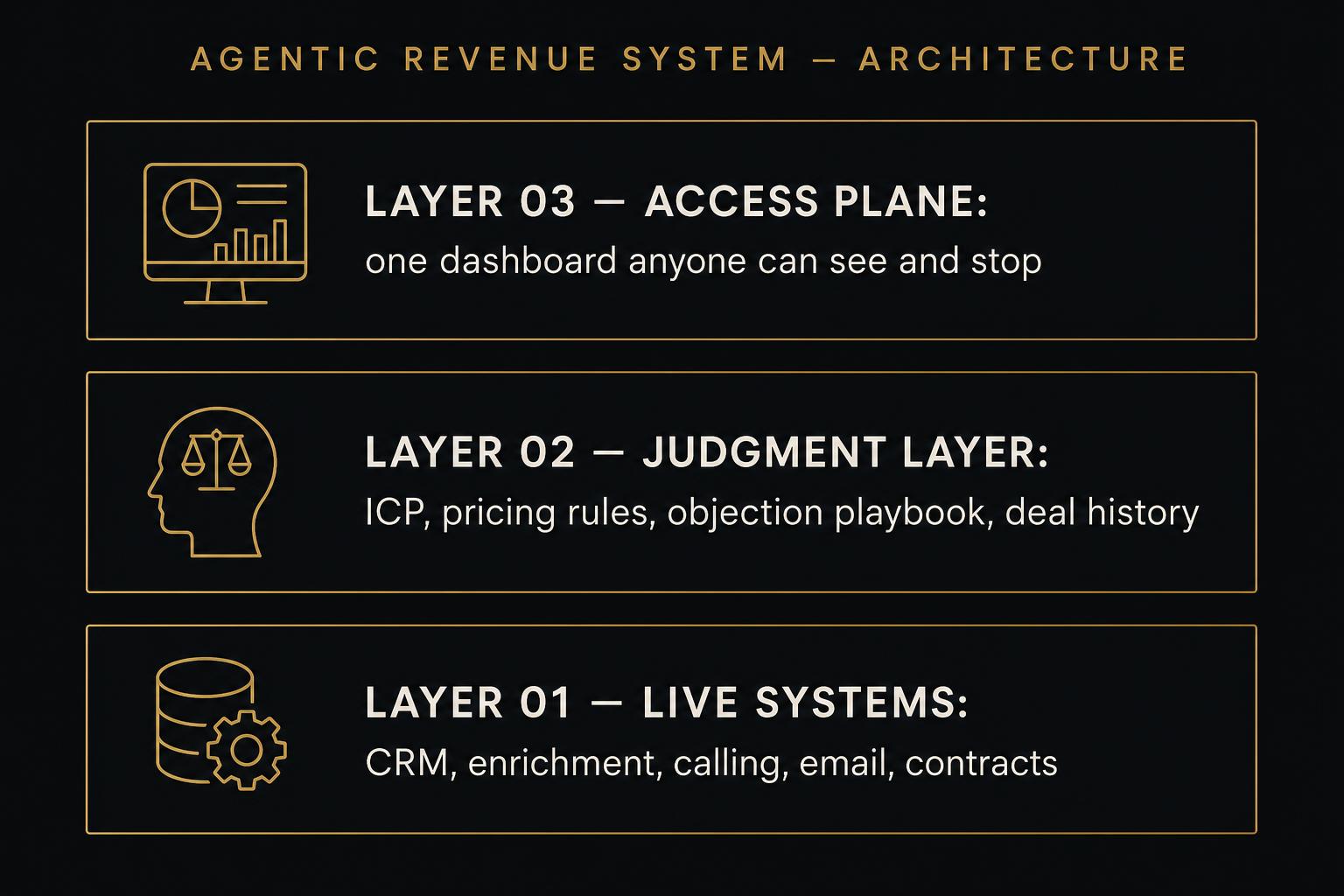
The middle layer is the one nearly everyone skips, and it is the one that determines whether any of this works. Your ideal customer profile, your pricing logic, how you handle the five objections you always get, and the record of deals you won and lost — written down in one place the system reads before it acts. Without it, you have automated generic outreach at scale, which is a reputational liability, not an advantage.
Map jobs, not job titles
You cannot automate an SDR. You can automate the sixteen repeated tasks an SDR does between Monday and Friday. This is the difference between an AI program that ships and one that stalls in committee: the unit of automation is a job to be done, with a defined input, a defined output, and a way to tell whether it went well.
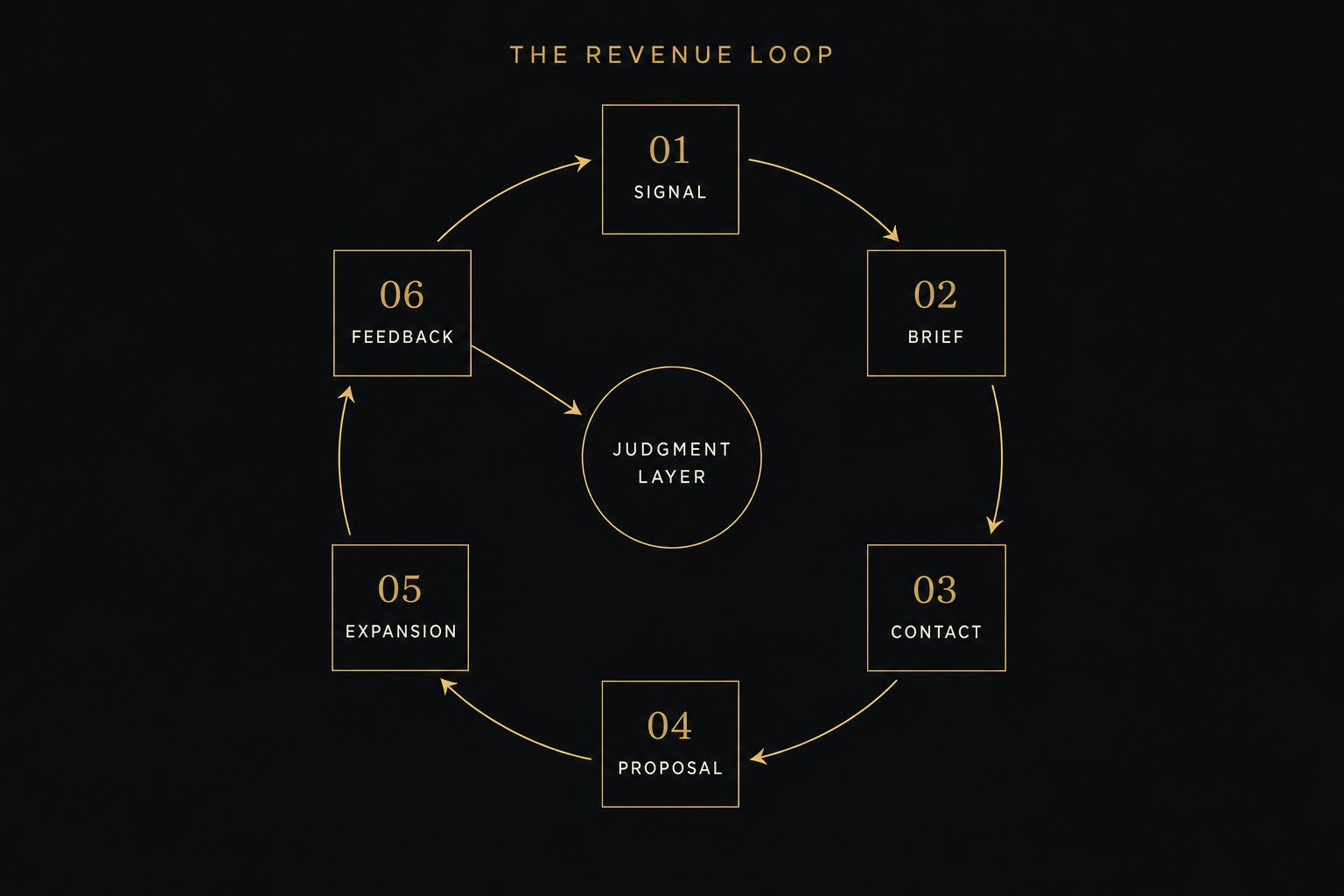
Two things about this loop are worth pausing on. First, it never stops. A signal that appears at three in the morning gets a brief by breakfast, which matters more than most teams admit — speed to first contact is still the single most reliable predictor of whether a deal happens at all.
Second, the last stage is the one that compounds. Feeding outcomes back into the judgment layer is what makes month six meaningfully better than month one. A system without that feedback path is a very fast way to repeat the same mistakes.
Someone has to be in charge
A dozen autonomous processes acting on the same accounts without coordination is not an operating system, it is a collision. The fix is an orchestration layer with a boring job description: route the work, hold the forecast, enforce the rules, and decide what gets escalated.
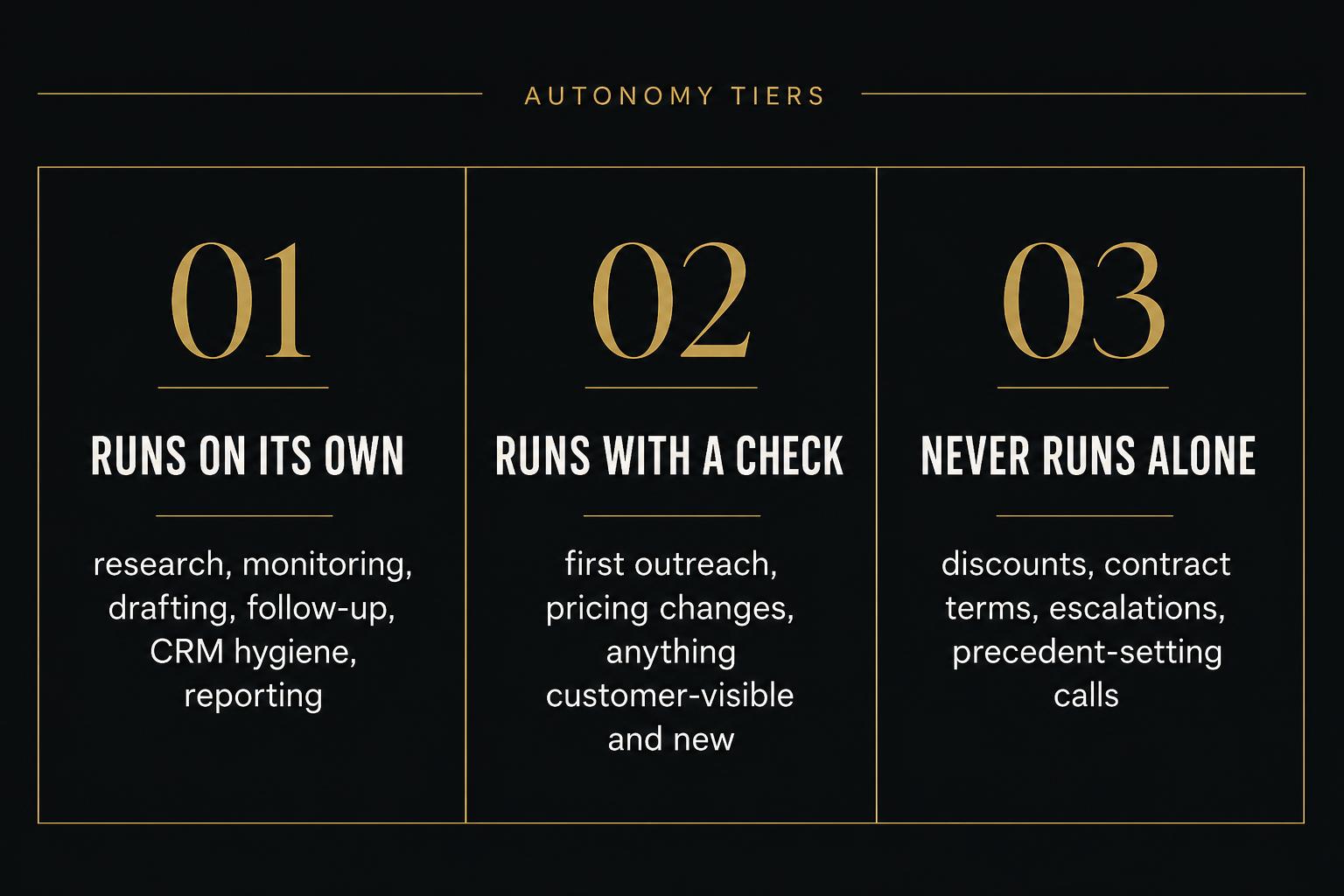
We push clients to write those three tiers down before a single workflow goes live. It takes an afternoon, it is not a technical exercise, and it is the difference between a system leadership trusts and one that gets quietly switched off after the first embarrassing email.
The AI should carry the groundwork. The human should own the moments that set a precedent.
What this actually buys you
Not headcount reduction — that is the wrong frame and usually the wrong outcome. What it buys is coverage and consistency. Every inbound lead gets a response in under a minute. Every account gets researched before someone reaches out. Every call produces a follow-up. Every closed deal, won or lost, makes the next one slightly easier to run.
None of that requires a bigger team. It requires deciding that the patient work belongs to a system, and then building the system carefully enough that you would put your name on what it sends.
Where to start
Pick one loop. Inbound response is usually the right first choice because the value is immediate and measurable: time from form submission to first human-quality contact. Instrument it, write the judgment layer for that one loop, set the control tiers, and run it for a month with a person reviewing every action.
Then expand. The teams that get this right do not start with twelve agents. They start with one loop that works and earn the right to build the rest.